

Sovereign Fair Share Assessment Methodology
Analytical framework for integrating Fair Share principles into sovereign climate pathway assessment through comparative evaluation of country-specific decarbonization methodologies
Context
Institutional sovereign investors face growing pressure to align portfolios with Paris Agreement objectives while accounting for differentiated national transition responsibilities. Recent IIGCC guidance on sovereign bonds and country pathways has increased focus on Fair Share principles as a core component of sovereign climate assessment frameworks.
At the same time, investors increasingly depend on external climate data providers for pathway alignment, country transition monitoring and benchmark construction. However, methodological differences between Fair Share approaches, least-cost pathways and country allocation frameworks create significant implementation complexity.
As sovereign net-zero methodologies become more integrated into benchmark construction, portfolio decarbonization and climate reporting processes, institutions require greater transparency regarding the assumptions, equity principles and operational implications embedded within sovereign climate pathway models.
Implementation challenge
Financial institutions face substantial difficulty interpreting and operationalizing sovereign Fair Share methodologies consistently across investment workflows.
Key implementation challenges include:
- Inconsistent Fair Share approaches across data providers
- Different treatment of responsibility, capability and equality
- Limited comparability between country pathway methodologies
- Insufficient transparency regarding specific pathway assumptions
- Operational uncertainty in benchmark selection
In practice, two countries with similar emissions profiles may receive materially different pathway expectations depending on methodological construction choices, temperature assumptions, LULUCF treatment or effort-sharing logic. This creates implementation friction for investors seeking coherent sovereign climate frameworks across reporting, engagement and portfolio construction activities.
Framework architecture
The methodology is structured as a comparative analytical framework for assessing how Fair Share principles are operationalized across sovereign climate assessment systems.
The framework consists of five primary analytical layers:
- Fair Share Principle Layer
- Pathway Construction Layer
- Comparative Methodology Layer
- Institutional Interpretation Layer
- Visual Analytical Layer
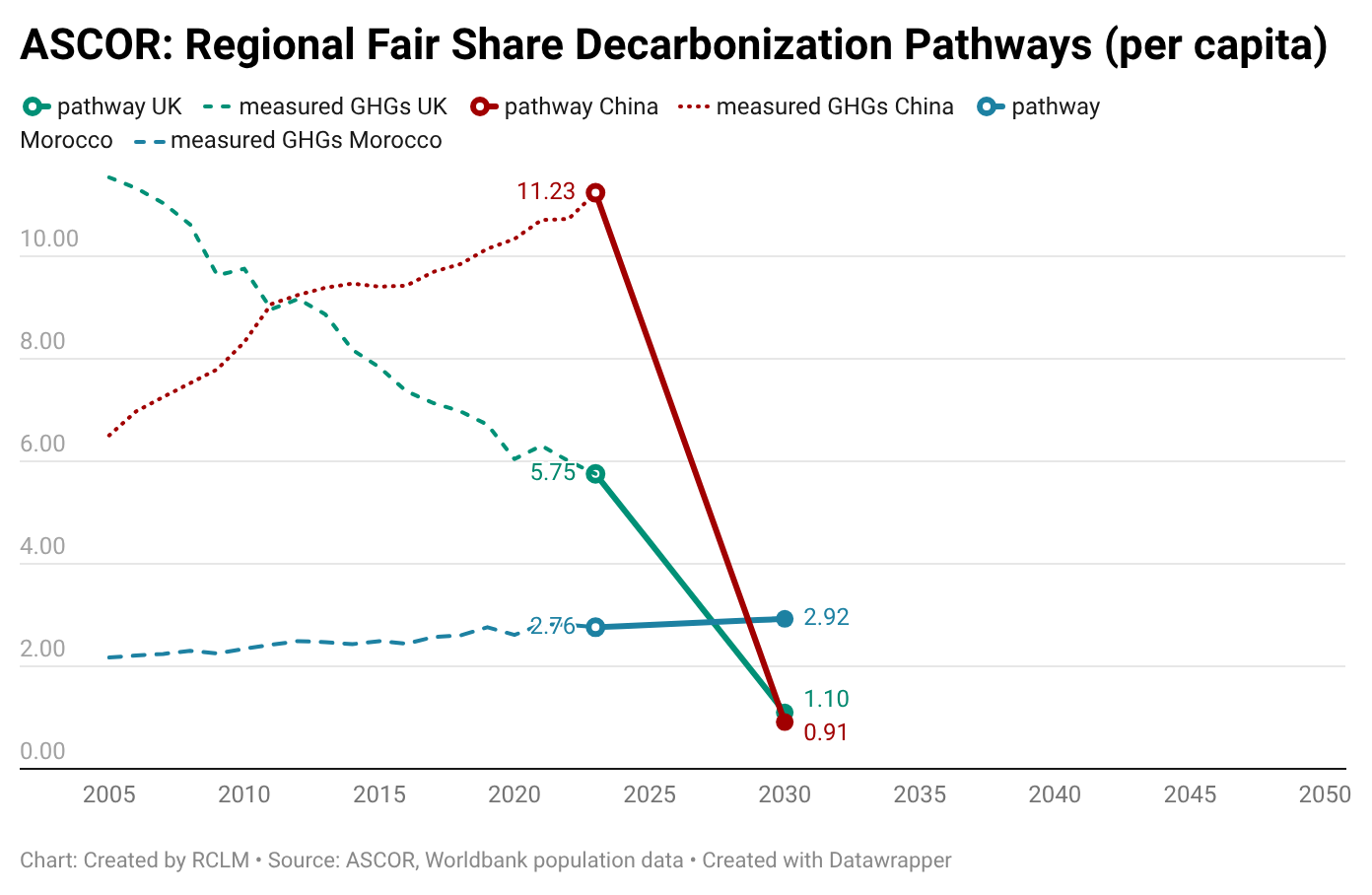
Comparative pathway analytics and cross-country visualizations support institutional interpretation of pathway dispersion, temperature alignment differences, Fair Share allocation outcomes, and country-specific transition expectations.
Implementation workflow
The methodology functions as a supporting analytical infrastructure layer within sovereign climate implementation workflows.
Institutions may integrate the framework into operational processes through:
- Sovereign Pathway Interpretation
- Benchmark Selection Support
- Transition Assessment Integration
- Reporting & Governance Support
- Comparative Scenario Analysis
The methodology enables comparative evaluation of how pathway assumptions alter sovereign climate outcomes across providers and temperature scenarios.
Use cases
The methodology can support a range of sovereign fixed-income implementation workflows, including:
- Fair Share pathway assessment
- Sovereign net-zero governance support
- Climate reporting methodology alignment
- Transition-risk analysis for sovereign portfolios
Implementation example
The methodology has been translated into comparative analytical infrastructure supporting sovereign climate pathway interpretation and methodological assessment workflows. The resource currently represents a deployable analytical methodology layer.

Advisory integration
RCLM may support institutional integration of the methodology through advisory-driven sovereign climate assessment workflows. Potential integration areas include:
- Country benchmark methodology review
- Pathway provider comparison exercises
- Fair Share governance assessments
- Climate reporting methodology alignment
- Sovereign debt net-zero implementation support
From framework architecture to implementation
The Sovereign Fair Share Assessment Methodology is part of RCLM’s broader implementation advisory approach focused on helping sovereign fixed-income teams operationalize climate-related sovereign investment processes.
Resource Snapshot
Operational characteristics of this implementation resource.


