

Climate-Adjusted Sovereign Benchmark Framework
Operational framework for integrating country climate performance into investable bond allocations through climate-adjusted country weighting, dynamic tilting and institutional portfolio constraints.
Context
Traditional sovereign bond benchmarks allocate capital primarily according to debt outstanding rather than climate performance. As a result, countries with limited climate ambition may continue to receive substantial benchmark representation, while climate leaders remain structurally underweighted.
Institutional investors increasingly require allocation frameworks that integrate climate considerations directly into sovereign bond construction without compromising investability, liquidity or diversification. The Climate-Adjusted Sovereign Benchmark Framework addresses this challenge by embedding climate performance into a transparent and rules-based sovereign weighting methodology.
Implementation challenge
Integrating climate considerations into sovereign fixed-income allocations presents several structural challenges:
- translating climate performance into systematic allocation rule
- ensuring transparent and repeatable implementation
- preserving benchmark investability while increasing climate alignment
- avoiding excessive country concentration
- maintaining sufficient liquidity and market realism
The framework addresses these tensions through a combination of standardized climate scoring, dynamic tilting, capping mechanisms and redistribution logic.
Framework architecture
The methodology follows a structured multi-stage allocation process designed for institutional implementation:
- Bond Selection: Defines the eligible bond universe using transparent rules
- Green Bond Rewarding: Includes Green Bonds to strengthen climate incentives
- Climate Score Standardization: Transforms climate data data into relative z-scores
- Exponential Tilting: Applies climate-adjusted country overweighting and underweighting
- Relative and Absolute Capping: Prevents excessive concentration risk
- Redistribution Rules: Redistributes excess capped weight across eligible countries
- Dynamic Tilt Optimization: Determines the strongest permissible climate tilt
- Bond-Level Downscaling: Allocates final climate-adjusted country weights to bond-level
Implementation workflow
The framework combines sovereign climate data with systematic allocation engineering. To improve robustness and reduce short-term volatility, the methodology applies weighted multi-year averaging of sovereign climate scores.
Country allocations are then adjusted using an exponential tilting function that dynamically determines the strongest feasible climate integration level while respecting investability constraints.
Additional controls include:
- relative capping
- dynamic absolute capping
- iterative redistribution
- counter-tilt tolerance controls
- proportional bond-level downscaling
This creates a climate-optimized sovereign allocation framework that remains operationally investable for institutional fixed-income portfolios.
Use cases
The framework can support a wide range of sovereign fixed-income applications, including:
- Climate-adjusted sovereign benchmarks
- Paris-aligned sovereign bond allocations
- Sustainable fixed-income mandates
- Climate risk-integrated government bond ETFs
- Climate reporting and allocation frameworks
Implementation example
The climate tilting framework has been translated into an operational sovereign allocation architecture supporting benchmark construction, portfolio implementation and index monitoring workflows.
The implementation converts sovereign climate assessments into systematic overweight and underweight allocations relative to market-cap benchmarks through transparent climate-adjusted weighting logic.
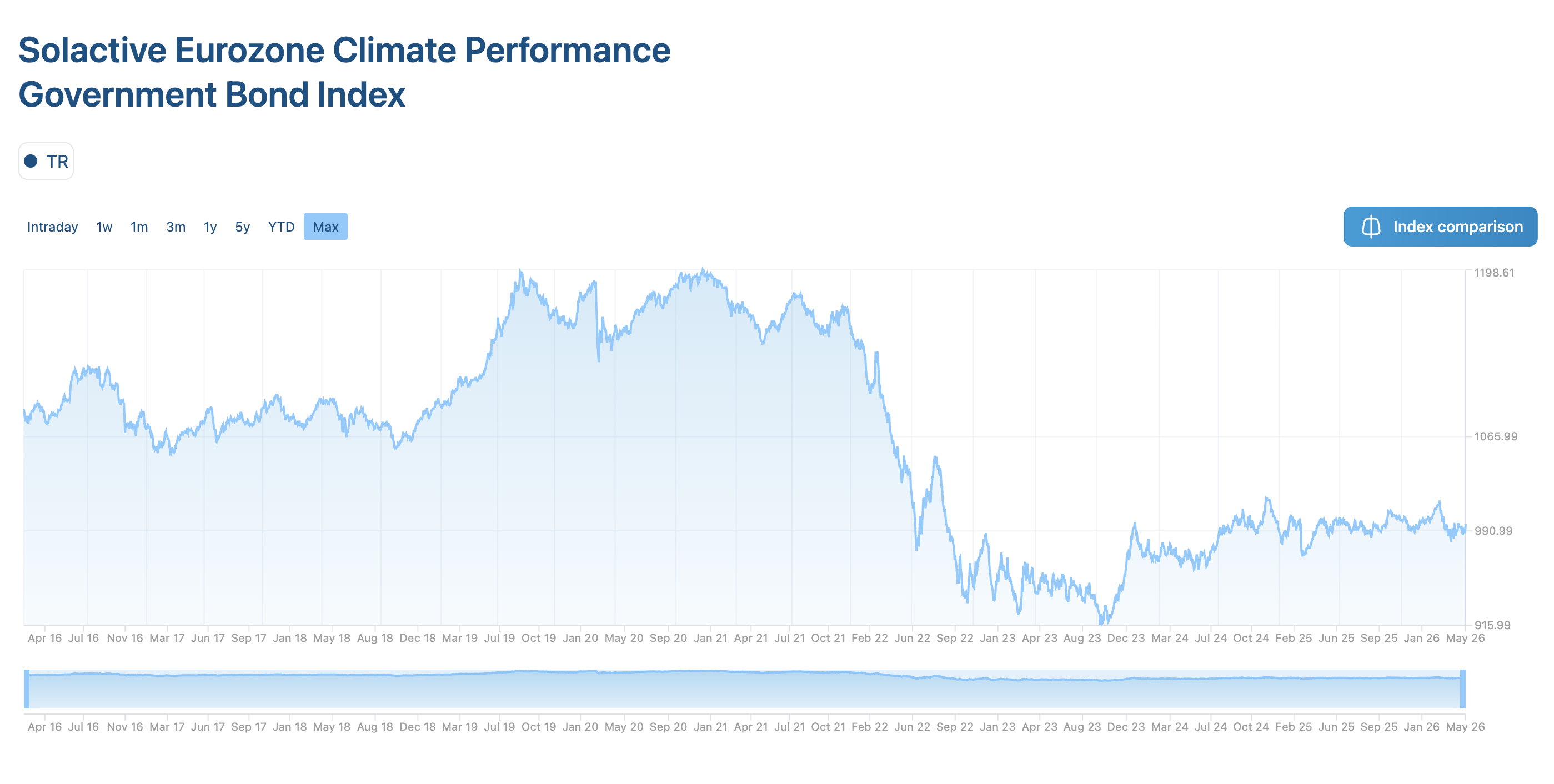
The framework has further been applied within a live sovereign climate index environment, enabling practical integration into institutional fixed-income processes.
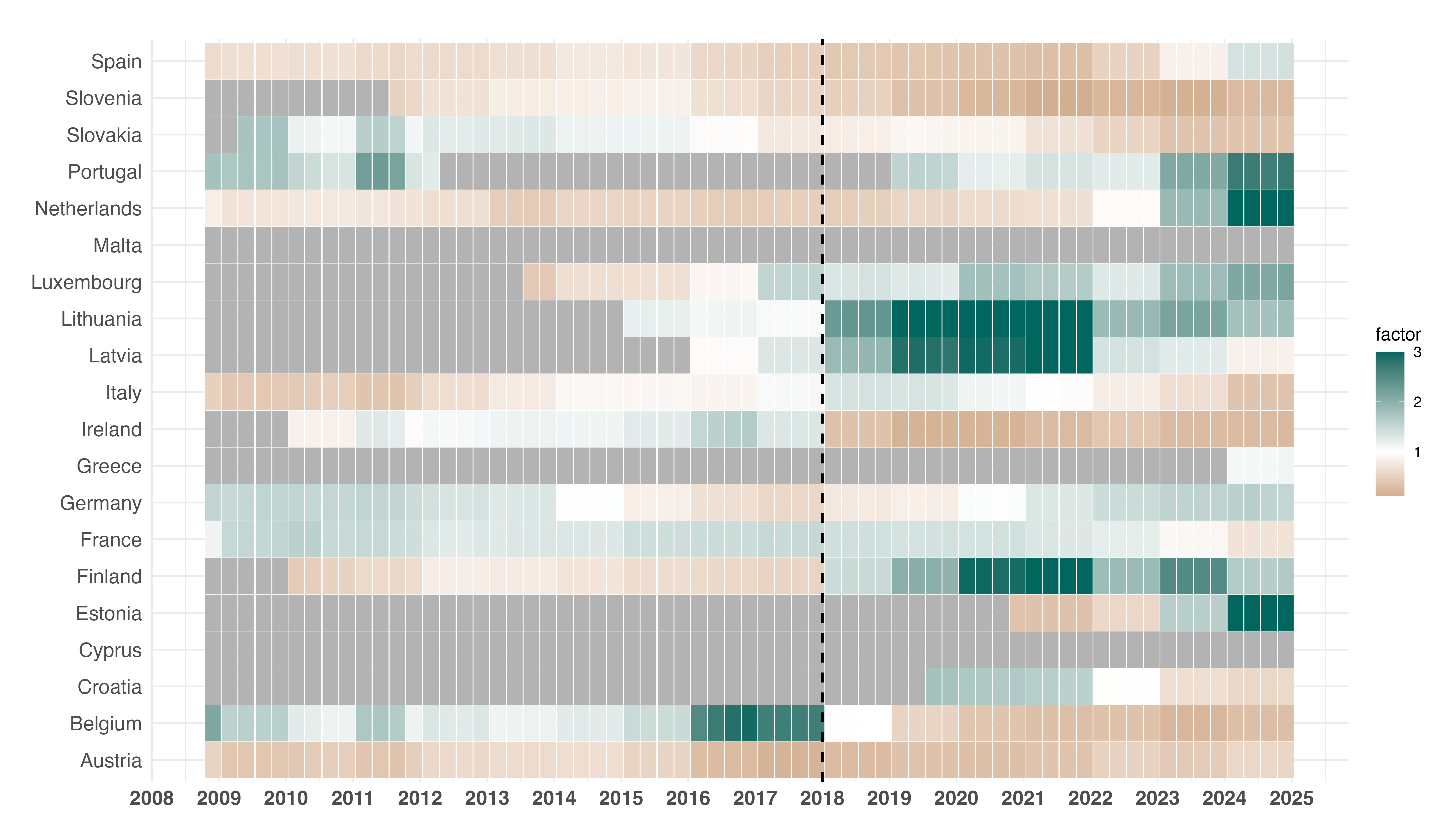
The methodology applies systematic climate-adjusted redistribution factors to sovereign market weights. Countries demonstrating stronger climate alignment receive overweight allocations, while lagging issuers are proportionally underweighted relative to the parent benchmark.
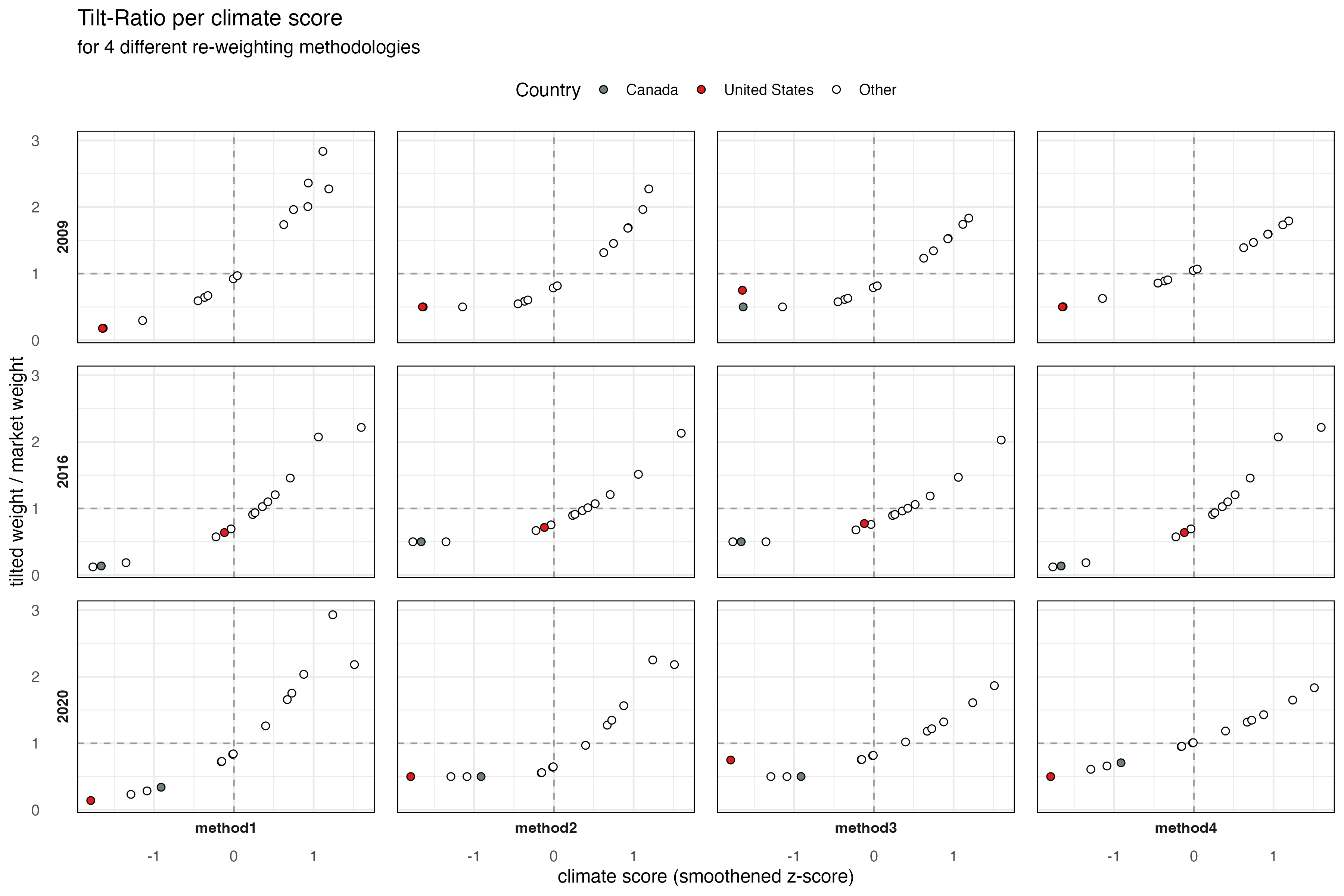
Climate scores are translated into allocation ratios through calibrated tilt functions using smoothed sovereign climate z-scores and predefined redistribution constraints. Different re-weighting methodologies can be applied depending on tracking-error tolerance and portfolio construction objectives.
Advisory integration
RCLM supports institutions in adapting and operationalizing sovereign climate allocation methodologies across investment and reporting workflows. Implementation areas include:
- Government bond benchmark design
- Climate-integrated portfolio construction
- Country weighting framework customization
- Climate reporting alignment
From framework architecture to implementation
The Climate-Adjusted Sovereign Benchmark Framework is part of RCLM’s broader implementation advisory approach focused on helping sovereign fixed-income teams operationalize climate-related sovereign investment processes.
Resource Snapshot
Operational characteristics of this implementation resource.


