

NZIF 2.0 Sovereign Implementation Framework
Operational architecture for translating NZIF 2.0 recommendations into practical sovereign fixed-income methodologies, reporting and climate alignment systems.
Context
Institutional investors increasingly face pressure to operationalize net-zero commitments across sovereign bond portfolios. While the IIGCC Net Zero Investment Framework (NZIF) 2.0 provides high-level recommendations for sovereign debt investors, many institutions still lack practical implementation architectures capable of translating these recommendations into measurable portfolio processes.
RCLM developed the NZIF 2.0 Sovereign Implementation Framework to bridge this gap between strategic climate commitments and operational portfolio implementation.
The framework provides a structured methodology for assessing sovereign net-zero alignment using country-level climate indicators, fair-share pathway logic and portfolio-relevant implementation criteria.
It is designed for asset managers, banks, pension funds and institutional investors seeking a practical framework for sovereign climate alignment analysis, reporting and implementation.
Implementation challenge
Many investors struggle to operationalize sovereign net-zero alignment due to:
- fragmented sovereign climate datasets
- inconsistent country methodologies
- lack of standardized sovereign alignment logic
- difficulties integrating fair-share considerations
- uncertainty around sovereign transition measurement
At the same time, sovereign fixed-income portfolios require climate approaches fundamentally different from corporate net-zero implementation.
Unlike corporates, sovereigns cannot simply be excluded from benchmarks without introducing major portfolio distortions, benchmark deviations and tracking-error implications. Investors therefore require methodologies capable of balancing climate alignment and portfolio construction constraints.
Framework architecture
The framework operationalizes NZIF 2.0 sovereign recommendations through six implementation dimensions:
- Long-Term Ambition: Assessment of national long-term decarbonization commitments and net-zero targets.
- Interim Targets: Evaluation of medium-term transition targets and alignment with country-specific pathways.
- Emissions Disclosure: Assessment of sovereign greenhouse gas reporting quality and disclosure coverage.
- Decarbonization Plan: Evaluation of national policy frameworks, implementation plans and climate governance structures.
- Emissions Performance: Assessment of actual emissions trajectories, climate performance trends and transition outcomes.
- Budget Allocation: Analysis of sovereign financial allocations and climate-related spending approaches.
Fair-share integration
The framework incorporates Common but Differentiated Responsibilities and Respective Capabilities (CBDR-RC) through differentiated pathway construction and country treatment logic.
Country-specific pathways are based on well-below-2°C climate scenarios and calibrated using differentiated convergence approaches.
This enables more institutionally robust sovereign comparisons across developed and emerging economies.
Implementation workflow
The framework is designed as an implementation architecture rather than a static scoring model.
Institutions can use the framework to build sovereign alignment assessments, transition monitoring workflows, sovereign engagement prioritization systems, and more.
The process typically follows five operational stages:
- Sovereign universe definition: Identification of country coverage and benchmark scope
- Indicator integration: Mapping of climate indicators, pathways and policy variables
- Alignment assessment: Evaluation of countries across the six NZIF dimensions
- Portfolio application: Translation into sovereign portfolio analysis and workflows
- Monitoring and recalibration: Ongoing reassessment of climate alignment over time
Use cases
The framework can support a range of sovereign fixed-income implementation workflows, including:
- Portfolio Construction
- Climate Reporting
- Engagement Prioritization
- Internal Methodology Development
- Benchmark and Index Analysis
Implementation example
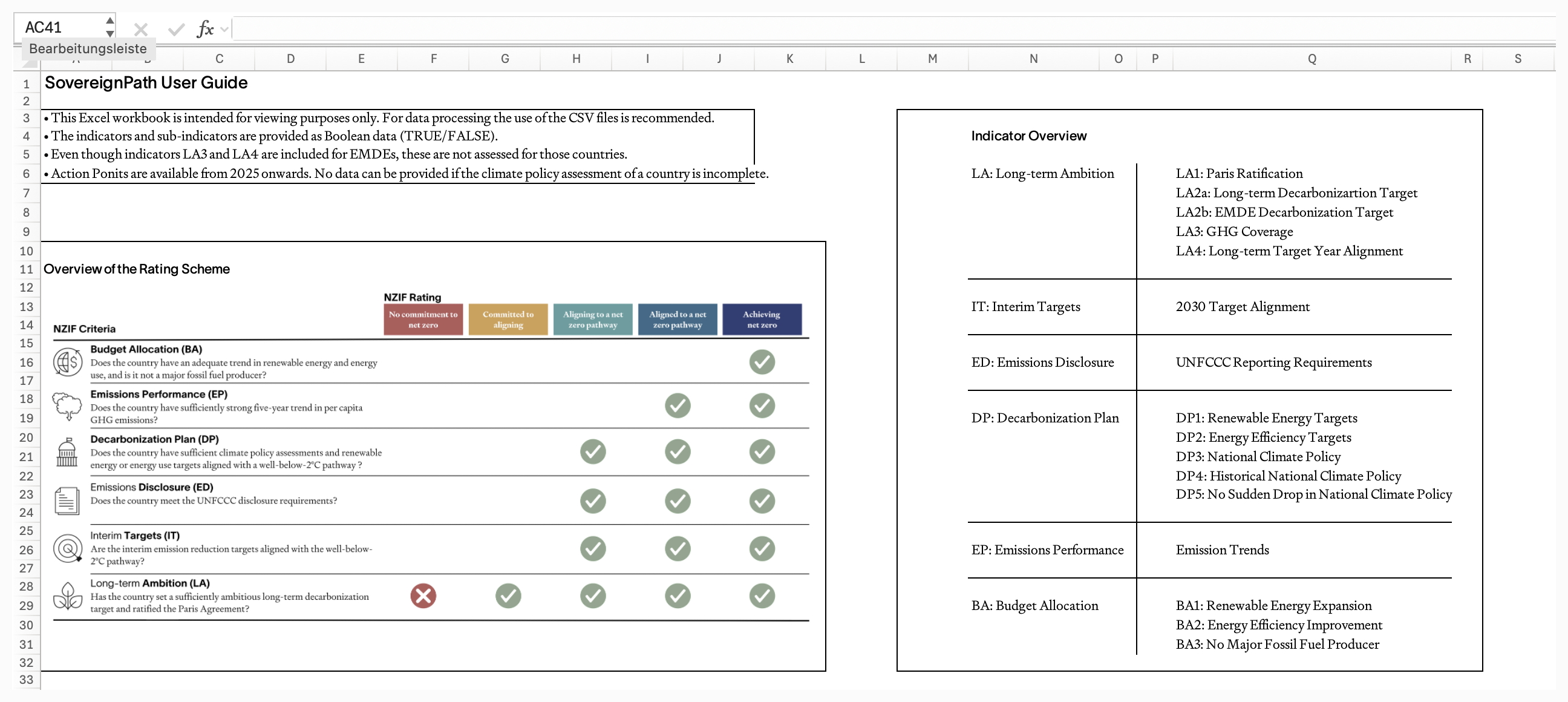
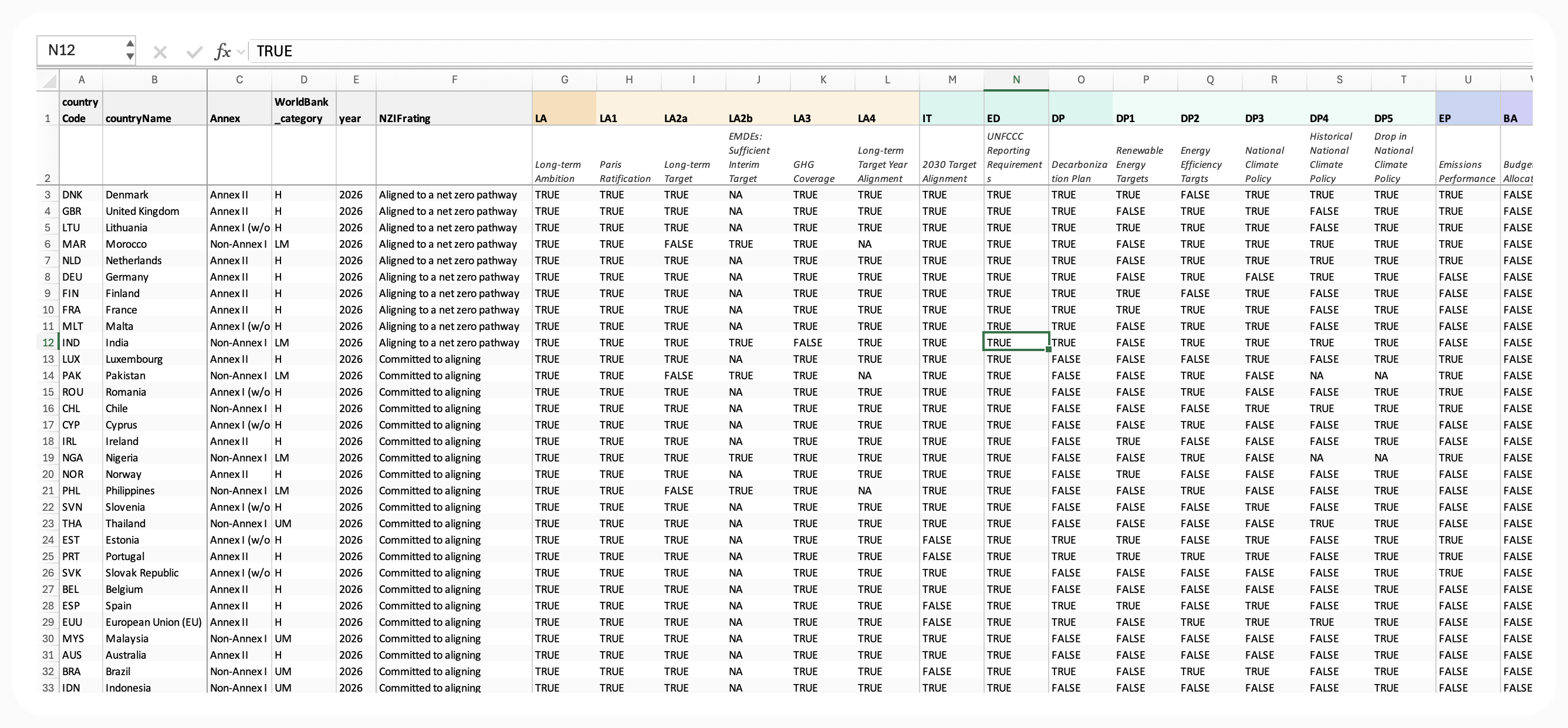
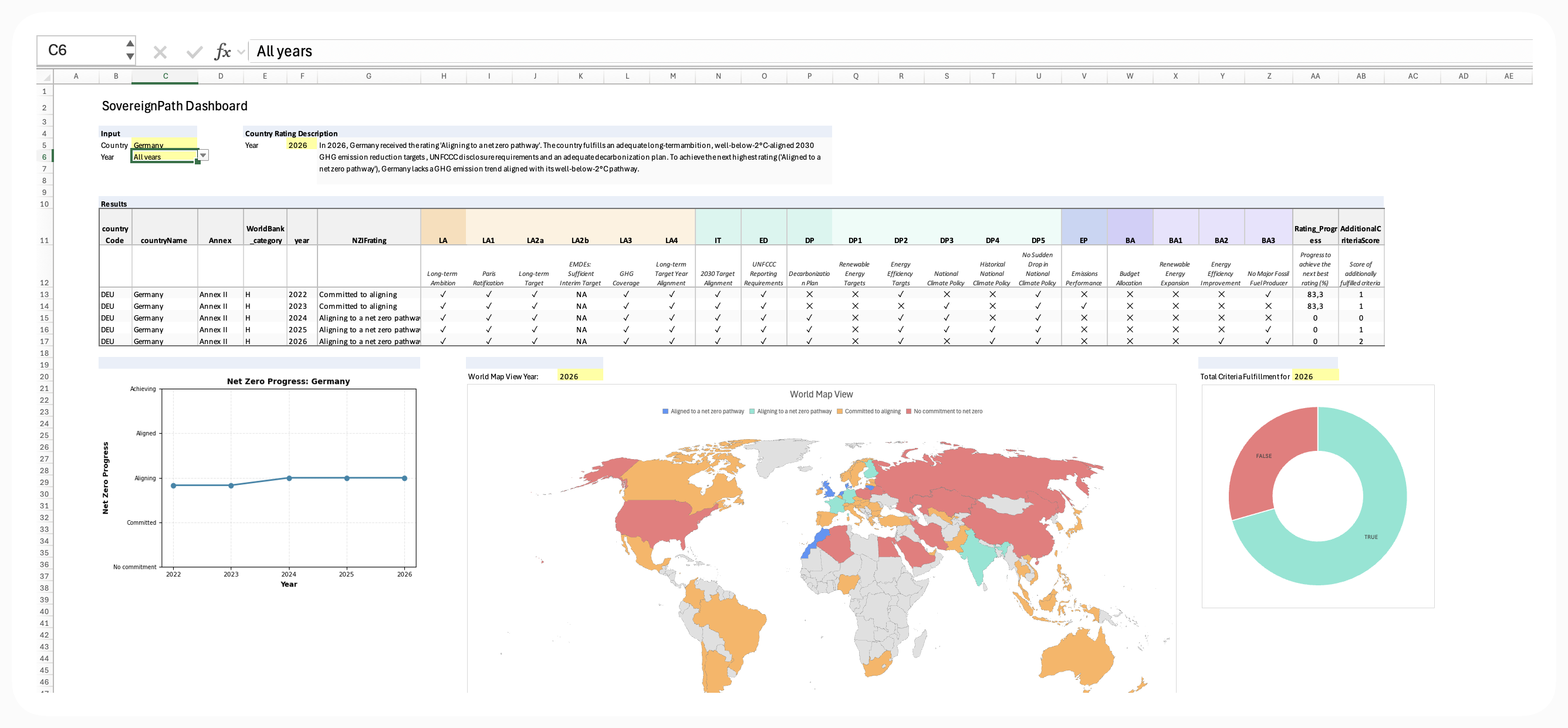
To demonstrate operational applicability, RCLM translated the NZIF 2.0 Sovereign Implementation Framework into a fully operational implementation environment combining sovereign alignment classification, indicator-level reporting, and historical progress tracking.
The framework has further been applied within a live country rating tool environment, enabling practical integration into institutional fixed-income processes.
Advisory integration
RCLM supports institutions in translating sovereign climate methodologies into operational implementation workflows. Advisory support may include:
- Full climate framework architecture
- Government bond alignment review
- Implementation gap analysis
- Climate data vendor selection
From framework architecture to implementation
The NZIF 2.0 Sovereign Implementation Framework is part of RCLM’s broader implementation advisory approach focused on helping sovereign fixed-income teams operationalize climate-related sovereign investment processes.
Resource Snapshot
Operational characteristics of this implementation resource.


